American Humanoid Robots to Battle Russian Soldiers on Ukrainian Frontline
Phantom MK-1 robots sent to Ukraine for battlefield evaluation as companies test new military technologies
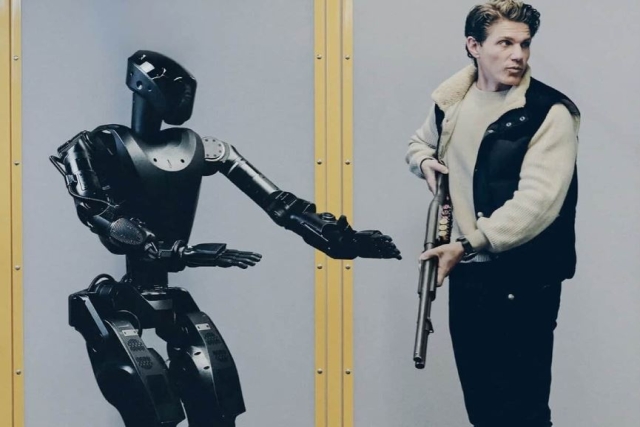
Ukraine has received two humanoid Phantom MK-1 soldier robots from the U.S.-based company Foundation to evaluate their potential use on the battlefield.
This is according to information provided by the company to Time.
The robots were delivered in February as part of efforts by defense startups to test emerging military technologies during the war in Ukraine, which has become a testing environment for new weapons systems.
Foundation plans to deploy the Phantom robots near frontline areas to assess their ability to support troops and refine the technology. Company co-founder Mike LeBlanc said the conflict reinforced his view that humanoid robots could have operational uses in combat zones.
“Humanoid soldiers could be invaluable for resupplying and conducting reconnaissance, especially in places drones cannot reach, such as bunkers. With a heat signature similar to a human’s, robots like Phantom could also confuse the enemy. We need something that can interact with all of these things,” LeBlanc told Time.
LeBlanc said the long-term goal is for the robot to be capable of operating “any weapon that a human can use.”
The Phantom system is undergoing testing at factories and shipyards in Atlanta and Singapore. Foundation also holds research contracts worth about $24 million with the U.S. Army, Navy, and Air Force.
Additional trials are planned with the U.S. Marine Corps, where the robot will be trained to place explosives on doors to support building-breach operations. LeBlanc also said the company is in “very close contact” with the U.S. Department of Homeland Security about possible future use of the robots for patrol missions along the southern U.S. border.
Foundation says it will follow Pentagon rules requiring human authorization before automated systems can engage targets.
LeBlanc, a former U.S. Marine Corps pilot who completed more than 300 combat flights, said his visit to Ukraine changed his view of modern warfare.
“This is a full-scale war of robots, where the robot is the primary fighter and humans only provide support. It’s the complete opposite of what it was during my service in Afghanistan: back then, people were the main force and technology was just a tool,” he said.
However, researchers say humanoid robots also present operational challenges. The machines are heavy, costly, require frequent charging, and depend on multiple motors to maintain balance and movement.
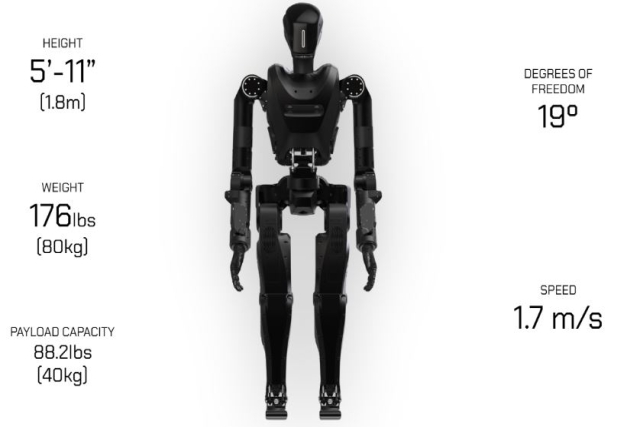
“A humanoid’s movement is powered by about 20 motors, and each of them must operate flawlessly,” said Pralad Vadakkepat, associate professor at the National University of Singapore and founder of the Federation of International Robotics and Football Associations.
Cybersecurity risks are also a concern. Captured drones have previously been used as sources of intelligence because they can store or transmit sensitive data. Analysts warn that hacked humanoid robots could present additional risks if hostile actors gain control of their software systems.
LeBlanc acknowledged that the technology remains in an early stage.
“What you’re seeing now is just the first clumsy attempt to show how robots could conduct our wars,” he said.
Artificial intelligence systems used in military platforms also face technical limits. Experts warn that AI can sometimes produce inaccurate outputs known as “hallucinations,” where systems generate incorrect information with high confidence.
“With these large language models, we cannot fully explain how they make decisions. It’s unacceptable to have lethal autonomous systems that occasionally decide to ‘hallucinate,’” AI researchers say.
During a visit by Time journalists, one Phantom robot reportedly fell several times during testing.
Foundation plans to introduce an upgraded Phantom MK-2 model in April. The new version is expected to include consolidated electronics, waterproofing, larger battery packs, and the ability to carry loads of up to 80 kilograms.
Separately, French military forces began testing robotic dogs alongside regular dogs in training exercises last year.
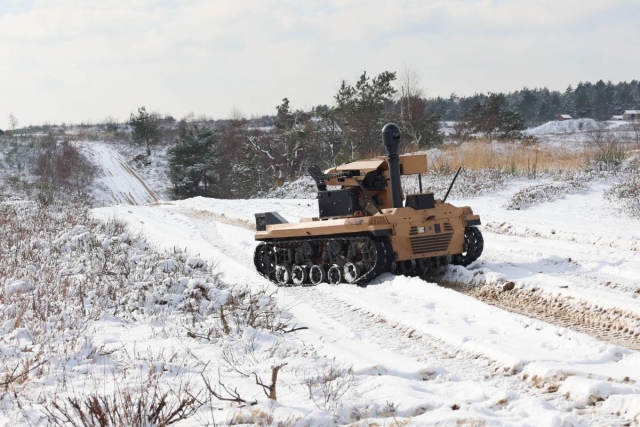
Turkish Military Shows Innovative Ground Robot During NATO Exercise
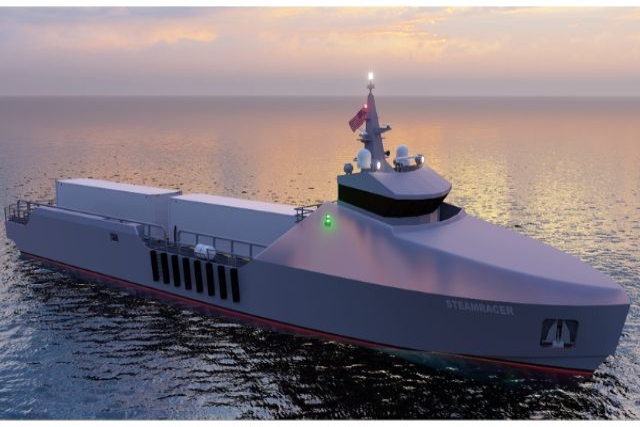
Sea Machines Robotics Unveils STEAMRACER-Class USV for Navy MASC Program
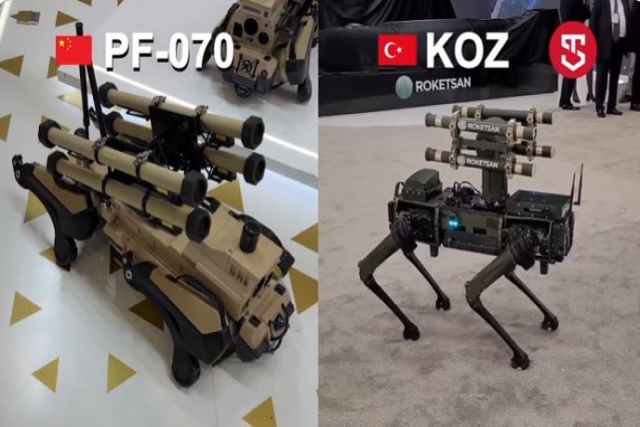
China Clones Turkey's Roketsan-made Robot Dog

Humanoid Robots to Feature in Serbia's Next Military Parade

Missed Patriot Interceptor, Not Iranian Drone Hit Kuwait Airport
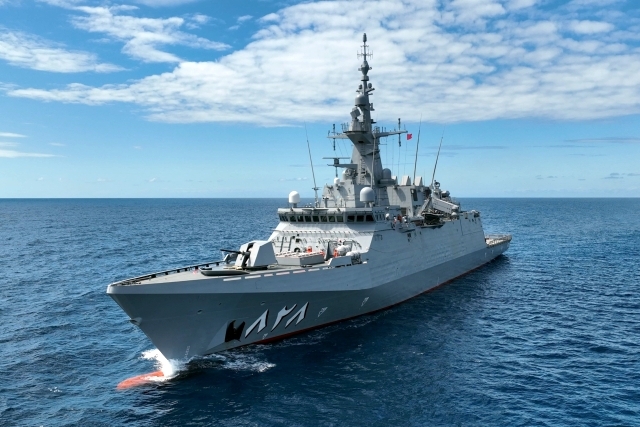
Spanish Navantia to Localize Warship Parts Production in Saudi Arabia

Russia Begins Building Prototype of Supersonic Airliner
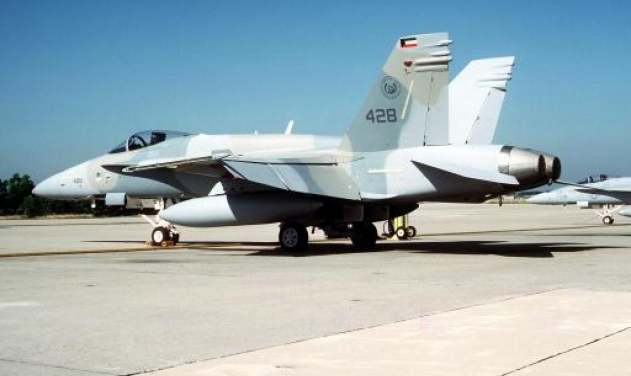
Switzerland Extends Life of F/A-18 Jets Till F-35s Arrival in 2030s...

One Month Since U.S., Israeli War Against Iran: Who Is Gaining?
One month after the United States and Israel launched coordinated strikes on Iran on February 28 the conflict has expanded...
Modern Tank Showdown: T-90MS, Leopard 2A7, M1E3 Abrams Compared
Main Battle Tanks (MBTs) have shown their mettle in recent conflicts such as in Ukraine despite being increasingly vulnerable to...
European Nations Prioritizing Europe-made IRIS-T & SAMP-T over American Patriot Air Defense Systems?
European nations looking to procure new air defense systems appear to be giving the much-vaunted American Patriot a miss in...
Russian T-90MS Crew Discuss Future Upgrades
Defense Mirror spoke with the crew members of the Russian T-90MS main battle tank, produced by UralVagonZavod
China's Mass-produced J-35A Aircraft Set to Disrupt Global Stealth Fighter Market
China is aiming to disrupt the global stealth fighter market by mass-producing its fifth-generation J-35A at a pace comparable to...

The Future of Combat: Miniaturized Laser Weapons Set to Replace Bullets and Missiles
Lasers may soon replace bullets, and drones could disable enemy UAVs with beams of light instead of missiles